How to Test Perfume Before Buying: Skin, Samples and Time
Testing perfume before buying means wearing it on your own skin for hours, not judging it from a paper strip. Here is how to use samples, avoid blind buys and make better fragrance decisions.

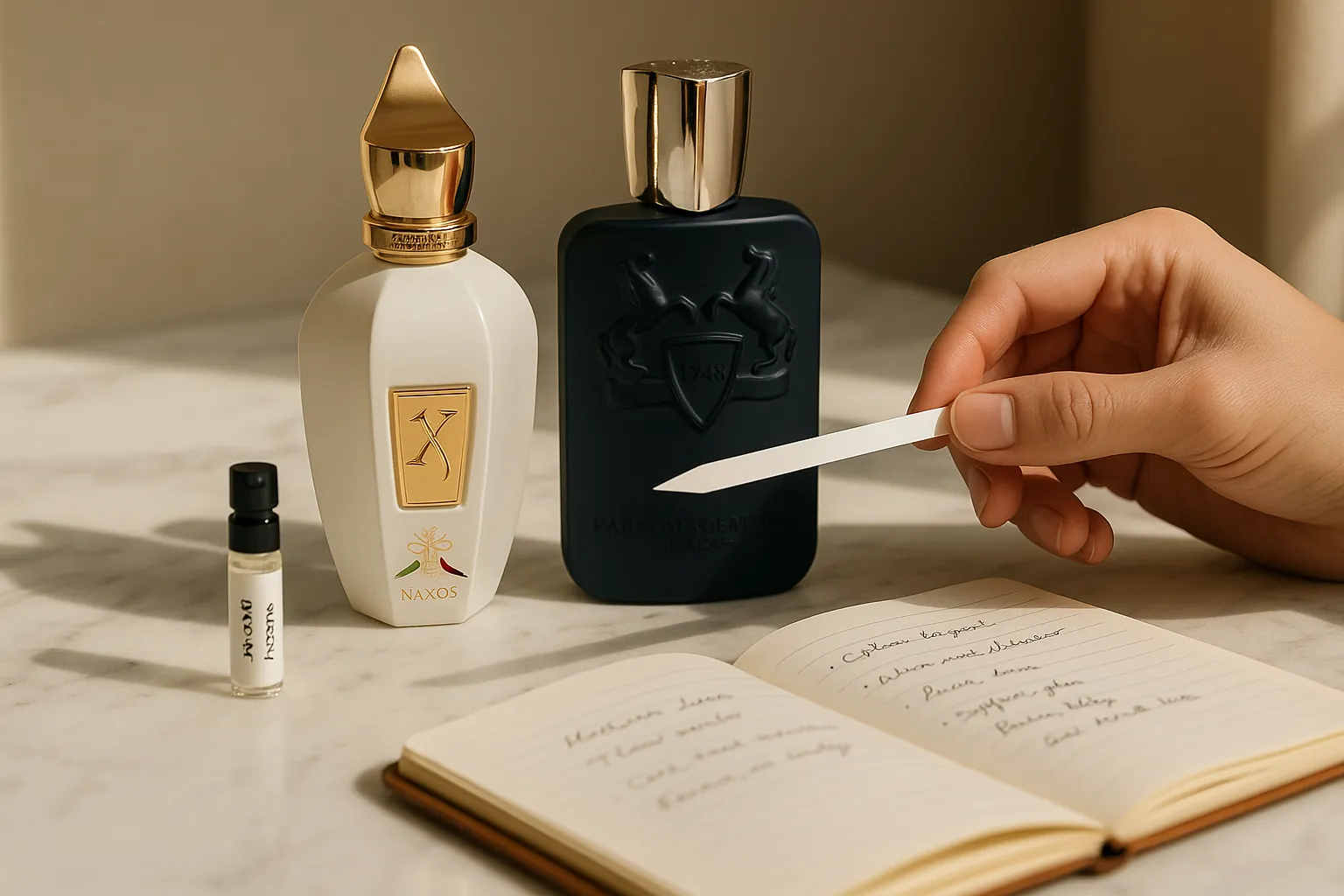
Why Testing Perfume Changes Everything
Imagine buying a bottle of wine for 250 euros - but you're only allowed to smell the sealed bottle. Sounds absurd? That's exactly how most people buy niche perfumes.
A full bottle costs between 100 and 400 euros. And yet, many people rely on a quick spray in the store or a YouTuber's recommendation. The result: expensive mistakes that gather dust as "shelf warmers."
In the fragrance community on Reddit and Parfumo, this is a perennial topic:
I'm 46 bottles in and roughly $2,500 down. I got lost in the sauce. Fell for the hype on multiple occasions. Now the honeymoon phase has subsided. I'm broke from all the blind buy fails.
Blindkauf ist ein Fehlkauf - das trifft leider bei mir zu. Habe ca. 50 solche Käufe in den letzten 2 Jahren getätigt.
(Translation: "Blind buying is a bad purchase - unfortunately that applies to me. I've made about 50 such purchases in the last 2 years.")
Understanding the Fragrance Pyramid - and Why It Matters for Testing
Every perfume tells a story in three acts. If you only hear the first, you miss what matters most.
Top Notes (0-20 Minutes)
The top notes are the first impression - light, volatile molecules like bergamot, lemon, or pepper that evaporate quickly. They're loud, striking, and often the reason we say "Wow!" in the store.
Heart Notes (20 Minutes to 3-4 Hours)
The heart notes are the true character of the perfume - this is where it shows what it's really about. Typical heart notes include jasmine, rose, iris, spices, or fruits. This is the scent you'll experience for most of the day.
Base Notes (From 3-4 Hours)
The base notes are the foundation. Heavy molecules like vanilla, musk, sandalwood, oud, or amber sink into the skin and last 8 hours or more. This "drydown" determines whether you truly love a perfume - or whether the initial magic fades.
Why You Need Hours, Not Minutes
Guerlain Shalimar is the textbook example: In the first 30 minutes, it smells sharp with bergamot and citrus - many people would reject it during this phase. After 3-4 hours, a creamy vanilla unfolds that ties everything together. After 8 hours, a golden, warm amber veil remains - revered by fragrance lovers worldwide.
If you judge Shalimar after 10 minutes, you miss one of the greatest perfumes in history.
The same principle applies to countless niche fragrances: An oud that initially smells medicinal can transform into velvety wood after hours. A sweet gourmand perfume that seems almost unpleasantly intense at first may become the perfect warm blanket in the drydown.
Your Skin Changes Every Fragrance - the Science Behind It
No perfume smells the same on two people. This isn't a marketing cliche - it's biochemistry:
Santal 33. Smelled it on men and women where it gains this fantastic mandarine, citrus fruit orchard vibe with musk and cedar... On me, it smells like pickle juice.
My mum smells really good wearing Angel. It makes me smell like piss.
Four factors determine how a fragrance performs on your skin:
Skin pH
Your skin's pH typically ranges between 4.5 and 5.5. That may sound like a small difference, but it has noticeable effects:
- More acidic skin breaks down fragrance molecules faster. Citrus and fresh notes may fade more quickly but seem more lively at first.
- More alkaline skin can amplify certain notes while muting others. Fragrances often smell warmer and sweeter.
Skin Type: Oily vs. Dry
- Oily skin holds fragrances significantly longer because natural oils bind the fragrance molecules and release them slowly. Projection (how far the scent carries) is also stronger.
- Dry skin lets fragrances evaporate faster. A tip: Apply an unscented moisturizer to your pulse points before spraying perfume - this can double the longevity.
Body Temperature
Pulse points (wrists, neck, behind the ears) are warmer because blood vessels run close to the surface. This heat activates fragrance molecules and enhances projection - but also accelerates evaporation.
Your Microbiome
Recent research shows that the bacteria on your skin actually metabolize the volatile compounds in perfume and transform them into new molecules. The perfume you apply is not necessarily the perfume others smell on you. Givaudan has even developed a technology (Z-Biome) where fragrance molecules are only activated by skin bacteria.
The 7 Biggest Mistakes When Testing Perfume
1. Testing Too Many Fragrances at Once
After 3-4 fragrances, olfactory fatigue sets in - a neurological phenomenon where your scent receptors become increasingly dulled. Scientific studies confirm that even moderate fragrance exposure significantly reduces olfactory performance.
Rule of thumb: A maximum of 3-4 fragrances per session. 1-2 of those on skin, the rest on test strips.
2. Judging by the Top Notes
The average interaction in a perfume shop: spray, sniff, decide - in under 30 seconds. That means you're only evaluating the most volatile, least representative molecules. You're tasting the appetizer and leaving before the main course arrives.
Minimum: 4-6 hours on skin before you pass judgment.
3. Only Testing on Paper Strips
Test strips are at room temperature (~22C), your skin is at ~37C. You can feel this 15-degree difference: many notes don't develop properly on cold paper. On top of that, there's no interaction with your pH, your skin oils, or your microbiome.
Test strips are good for narrowing down, not for falling in love. The final decision must happen on skin.
4. Testing in the Store Instead of at Home
A perfume shop with hundreds of open fragrances, other customers spraying, the salesperson wearing their own perfume - your nose is already partially fatigued before you even begin. Add to that the psychological pressure to make a decision.
Ich persönlich mag es sehr, Düfte zuhause zu testen. Dort kann ich mir Zeit nehmen.
(Translation: "Personally, I much prefer testing fragrances at home. There I can take my time.")
5. Rubbing Your Wrists Together
This is the most widespread myth in the fragrance world. The friction doesn't actually "destroy" molecules (they're too robust for that), but the generated heat accelerates the evaporation of the top notes. You skip the carefully composed opening and perceive the heart notes in a distorted way.
Better: Spray and let it air dry.
6. Ignoring Season and Weather
- Heat increases projection but makes fragrances fade faster. A "beast mode" perfume in summer can become a gentle skin scent in winter.
- Cold slows evaporation - fragrances last longer but project less.
- Humidity keeps the skin moist, which improves both longevity and projection.
Die Düfte riechen nicht anders - aber sie verhalten sich anders und man nimmt sie auch anders wahr.
(Translation: "The fragrances don't smell different - but they behave differently and you perceive them differently too.")
7. Not Documenting
After a week with 10 tested fragrances, your impressions blur together. Without notes, you're facing the same problem you started with.
Keep a simple fragrance journal (more on that below).
How to Test Perfume Like a Pro - Step by Step
Step 1: Prepare
- Don't wear any other perfume or strongly scented body lotion
- Ideally test in the morning (your nose is most sensitive then)
- Make sure the room has fresh air
Step 2: First Check on the Test Strip
If you have several fragrances to choose from, spray them on paper strips first. Wait 30 seconds (the alcohol needs to evaporate) and sniff. This way you quickly eliminate what's clearly not for you.
Limit: Max. 4-5 strips per session. Label them!
Step 3: On the Skin - Use Pulse Points
Spray your favorite from Step 2 on a pulse point - ideally the inner wrist or the crook of the arm. Hold the bottle 15-20 cm away. Don't rub.
Step 4: Check-ins Throughout the Day
This is where it gets exciting. Deliberately smell the test spots:
| Time | What to Observe |
|---|---|
| After 15 min | Top notes: First impression. Do you like the direction? |
| After 1 hr | Heart notes: The true character emerges. How do you feel wearing it? |
| After 3-4 hrs | Transition to base notes. Does the fragrance change significantly? |
| After 6-8 hrs | Drydown: The foundation. Do you still like the fragrance? |
Step 5: Evaluate Sillage and Longevity
- Sillage (scent trail): Extend your arm. Can you smell the fragrance at arm's length? That's the projection. Ask someone you trust: "Can you smell anything when I walk into the room?"
- Longevity: Note the time when you apply. When can you no longer smell it? 4 hours? 8? 12?
Step 6: Repeat
A single test isn't enough. Professional perfume critics live with a fragrance for days before passing judgment. For you, this means:
- Day 1: First test, document the full progression
- Day 2: Second test under different conditions (morning instead of evening, indoors instead of outdoors)
- Day 3+: Do you enjoy wearing the fragrance? Or was it just curiosity?
The rule of thumb from experienced collectors:
I start from 2ml. If I finish it quickly, I buy more. This has worked so well for me. I saved money and it really helped me to identify what I love, what I like, and what is just OK.
The Fragrance Journal: How to Document Your Tests
A simple system is all you need. For each fragrance you test, note down:
| Field | Example |
|---|---|
| Name | Xerjoff Naxos |
| Date & Weather | February 15, 8C, overcast |
| Top Notes (15 Min) | Sweet tobacco, honey, citrus - warm and inviting |
| Heart Notes (1-3 Hrs) | Lavender comes through, creamy, tobacco persists - very elegant |
| Base Notes (4+ Hrs) | Vanilla, tonka bean, soft tobacco - like an old reading room |
| Sillage | Strong in the first 2 hrs, then moderate scent trail |
| Longevity | 10+ hours on skin, still detectable on sweater the next day |
| Feeling | Confident, warm, intellectual |
| Occasion | Fall/Winter, evening, special occasions |
| Verdict | Buy full bottle |
Digital or analog - it doesn't matter, as long as you do it. After 10-20 documented fragrances, you'll start seeing patterns: which notes you consistently enjoy, which ones reliably bother you, which concentration and style suit you best.
Aufgrund präferierter Düfte dachte ich lange, meine Richtung wäre Gourmand. Heute weiß ich, dass das so nicht stimmt.
(Translation: "Based on my preferred fragrances, I long thought my direction was gourmand. Today I know that's not quite true.")
Where to Test Niche Fragrances - Without Spending a Fortune
Niche perfumes are expensive. But testing them doesn't have to be.
Order Samples and Decants
2ml samples cost between 3 and 15 euros depending on the brand and retailer. Many shops let you put together a sample set and credit the amount toward a full bottle purchase later.
Those 2ml give you 15-20 sprays - enough for 3-5 complete testing days. More than enough to make an informed decision.
Get Advice Online, Test at Home
The biggest challenge with samples: How do you know which ones to order? With over 1,000 niche fragrances out there, it quickly becomes a lottery.
That's why at Parfinity we focus on thorough consultation - online too. On our website, you'll find detailed profiles for every fragrance with scent notes, style direction, and occasion. There's also an AI fragrance advisor that knows the entire catalog in detail: describe what you're looking for or what you enjoy, and it will suggest specific fragrances. From there, you put together a discovery box, test at home at your own pace - and when you find your favorite, the box amount is credited toward the full bottle.
No guessing, no blind buying.
Visit a Niche Perfumery in Person
If you prefer personal advice: Specialized niche perfumeries offer a completely different experience compared to department stores - fewer fragrances, more guidance, less rush. At our store in Kiel (Holtenauer Strasse 83), you can test at your leisure and receive honest recommendations instead of sales pressure.
Use the Community
On Parfumo there's the "Souk" (marketplace), where collectors trade decants and leftover bottles. The r/fragranceswap community on Reddit works similarly. This way you can get your hands on rare fragrances that aren't available as official samples anywhere.
Cost Comparison
*With our credit model, the box amount is issued as a discount code for the full bottle purchase - the samples are effectively free.
Blind Buy Strategies: When There's No Sample Available
Sometimes a fragrance is so new, so rare, or so sold out that no sample is available. If you still want to blind buy, minimize the risk:
The 50-Euro Rule
A widely used rule of thumb in the community: Never blind buy above 50 euros. Below that, a bad purchase doesn't hurt too much. Above that, it becomes an expensive gamble.
Find Your "Fragrance Twin"
On Parfumo and Fragrantica, you can find users who like similar fragrances to yours. If someone with a nearly identical taste profile loves a fragrance, there's a higher chance you'll enjoy it too.
Learn to Read Notes
If you know you love vanilla and sandalwood but can't stand patchouli, a glance at the fragrance pyramid helps. Sites like Parfumo and Fragrantica list the notes of every fragrance.
Buy Small
If the fragrance comes in 30ml - take the small bottle.
Die bekommst du NIE auch nur zur Hälfte leer, nie. Also lieber die kleineren.
(Translation: "You'll NEVER even get those half empty, never. So better go with the smaller ones.")
The Coffee Bean Myth - and What Actually Helps
In almost every perfume shop, you'll find little bowls of coffee beans, supposedly to "reset" the nose. The truth: It doesn't work.
Dr. Alexis Grosofsky at Beloit College demonstrated in controlled studies that coffee beans offer no measurable advantage over simply breathing fresh air. What they actually do: The strong contrast creates the impression of refreshment. But the olfactory fatigue remains.
Testing Perfume as a Beginner: Where to Start?
If you're just diving into the world of niche fragrances and feeling overwhelmed by 1,000+ options - here's a pragmatic starting point:
-
Find your fragrance family. Do you prefer fresh citrus scents, warm oriental notes, creamy gourmand fragrances, or woody aromas? A first clue: Which everyday smells do you enjoy? Freshly baked bread, forest air after rain, vanilla pudding, leather gloves? If you have no idea where to begin: Our AI fragrance advisor will ask you a few questions and suggest specific fragrances - no prior knowledge needed.
-
Start with a sample box. Put together 5-6 fragrances from one fragrance family or matching your preferences - this way you learn the differences within a style without committing.
-
Test one fragrance per day. No stress, no comparing. Apply it in the morning and live with it. In the evening, note down your impressions.
-
Trust your nose, not the hype. The most popular fragrance on TikTok doesn't have to be your favorite. This realization comes to almost everyone who tests systematically.
-
Enjoy the journey. Discovering perfume is a voyage, not a sprint:
Seine Vorlieben kann man leider erst besser eingrenzen, wenn man viel getestet hat.
(Translation: "Unfortunately, you can only narrow down your preferences once you've tested a lot.")
Frequently Asked Questions
Summary: The 5 Golden Rules
- Test on skin, not just on paper. Your skin chemistry changes every fragrance.
- Wear it for at least 4-6 hours. The base notes determine whether you truly love a fragrance.
- A maximum of 3-4 fragrances per session. After that, olfactory fatigue sets in.
- Test over several days. What excites you today may bore you tomorrow - and vice versa.
- Document everything. A fragrance journal helps you recognize patterns and make better decisions.
Ready to get started? Grab 2-3 samples from a fragrance family that appeals to you, set up a simple journal - and give each fragrance at least two days. The rest will follow naturally.
Read next
Train Your Nose: How to Truly Understand Fragrances
Your nose is capable of more than you think. How to learn to identify individual fragrance notes, why sandalwood is not just sandalwood - and what a deaf composer has to do with perfumery.