Train Your Nose: How to Truly Understand Fragrances
Your nose is capable of more than you think. How to learn to identify individual fragrance notes, why sandalwood is not just sandalwood - and what a deaf composer has to do with perfumery.

Why Your Nose Deserves Training
You can name colors. You can pick out instruments in an orchestra. But can you tell whether the sandalwood in your perfume comes from India or Australia? Whether the base relies on Ambroxan or real ambergris?
Most people perceive fragrances as a whole - "smells good" or "doesn't smell good." That's like hearing an orchestra and only being able to say: "sounds loud." With a bit of training, you can hear the individual instruments. And that's exactly the difference between liking a perfume and understanding it.
The painter learns to see, the pianist learns to listen, I learned to smell.
- Jean-Claude Ellena, The Diary of a Nose
Step 1: Learn to Smell Consciously
Training doesn't start at the perfume counter - it starts in everyday life. Your nose is constantly at work; you've simply forgotten how to listen to it.
In Everyday Life
- In the kitchen: Consciously smell spices before adding them to your food. How does cinnamon differ from cardamom? What makes vanilla extract different from vanilla sugar?
- Outdoors: What does freshly mown grass smell like? Wet earth after rain? Autumn leaves? Name what you smell - and try to describe why.
- At the supermarket: The fruit section is a natural training ground. Smell lemons, oranges, grapefruits - all "citrus," but each one different.
Francis Kurkdjian, founder of Maison Francis Kurkdjian, recommends exactly this approach:
They can start with basic stuff - smelling flowers, smelling kitchen herbs, paying attention. They have to connect their brain to the nose.
With Perfumes
- Compare two fragrances side by side. Spray each on a paper strip (or on each wrist) and alternate between them. What's similar? What's different?
- Smell throughout the day. Spray in the morning and consciously check in every 1-2 hours. How does the fragrance change? When does the top note disappear? When does the base come through?
- Keep a fragrance journal. Write down what you smell - even if it's just "warm" or "somehow green." The words will become more precise over time. We cover how to systematically test, compare, and document fragrances in detail in our guide to testing perfume properly.
The AI fragrance advisor on parfinity.com can help you find the right terminology. Simply describe what you smell, and it will explain which notes it could be.
Step 2: Get to Know Individual Fragrance Notes
The biggest leap comes when you smell individual raw materials in their pure form. In a finished perfume, dozens of materials overlap - making it nearly impossible to pick out individual notes if you've never smelled them in isolation.
You must first master the technique before even thinking about creativity. Without technique, nothing can be done.
- Dominique Ropion, Master Perfumer at IFF
Training Kits: Your Personal Perfumer's Organ
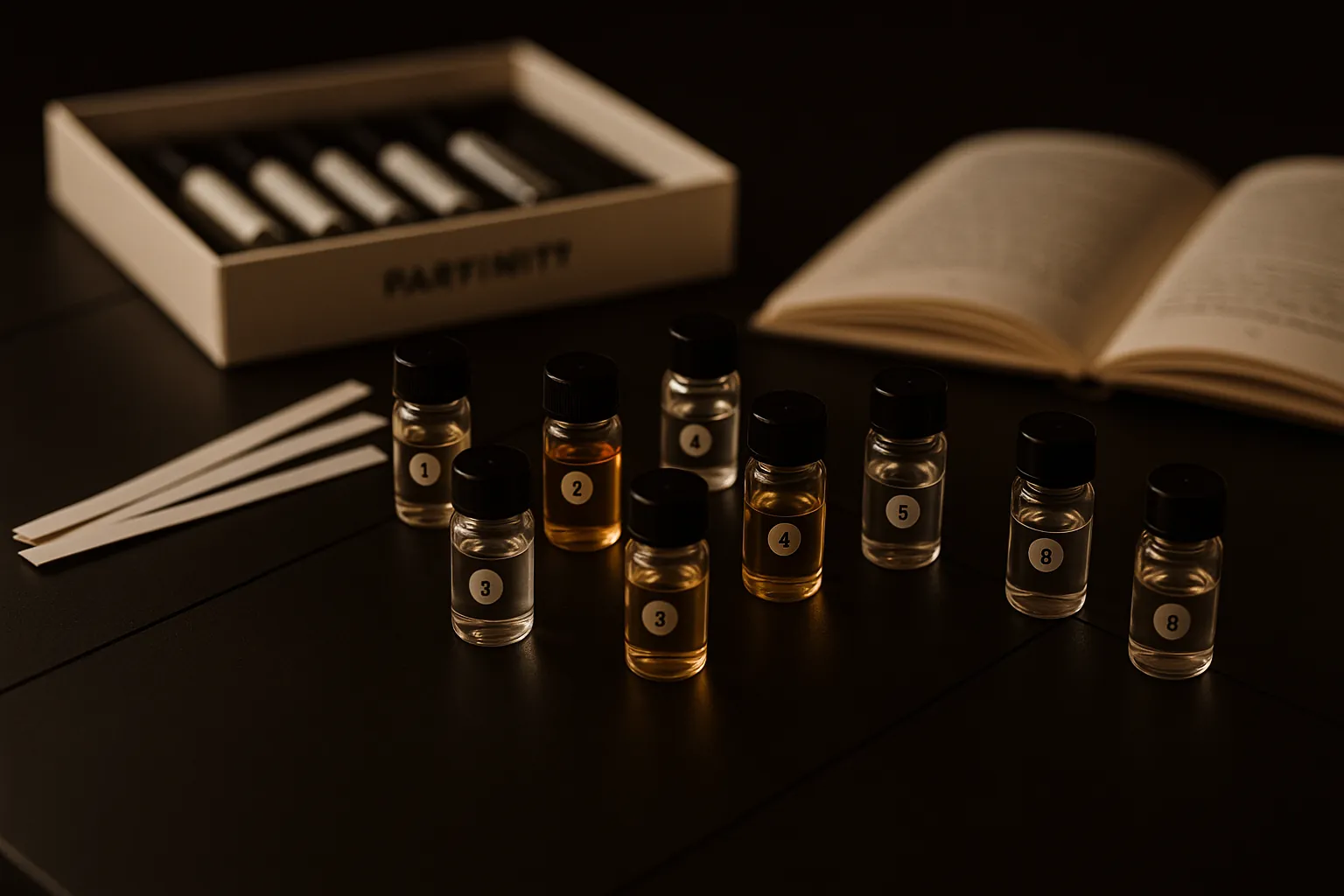
There are sets that deliver isolated fragrance notes in small vials - from individual essential oils to synthetic molecules. It's like learning vocabulary: before you can build sentences, you need to know the words.
Smell is a word, perfume is literature.
- Jean-Claude Ellena, Perfume: The Alchemy of Scent
Well-known providers of training kits (we don't sell these, but they are an excellent complement to perfume testing):
- Pell Wall - 56 aroma chemicals, ideal for beginners (approx. £231)
- The Perfumer's Apprentice - 50 classic perfumery raw materials in pure form (approx. $259)
- Experimental Perfume Club - 15 vials per box, with accompanying booklet (approx. £55 per box)
- PerfumersWorld - 160 materials for serious students (approx. $874)
How to Train with a Kit
- Smell 5-10 materials per day. No more, or you'll overwhelm your nose.
- Take notes. What do you associate? How would you describe the scent?
- Form pairs. Smell vetiver next to patchouli - both "earthy," but fundamentally different. Or bergamot next to lemon - both "citrus," but with a completely different character.
- Repeat after a week. Can you recognize the materials again? That's the moment when real learning happens.
- Test yourself blind. Have someone pick a vial without you seeing the label. Can you identify it?
After a few weeks, you'll start recognizing individual notes in finished perfumes. "There's vetiver in this!" or "The base is clearly ambergris." That's the point where perfumes stop being puzzles - and start telling stories.
Why a Note Is Not Just a Note
This is where things get really exciting. When you read "sandalwood" in a fragrance description, you might think that's straightforward. It's not. Not even close.
Sandalwood: One Note, Many Worlds
Indian Mysore sandalwood (Santalum album) - with up to 90% santalol content, it's the gold standard: creamy, warm, velvety, sensual. Like condensed cream with a hint of clove.
Australian sandalwood (Santalum spicatum) - softer, lighter, fresher. More "fresh milk" than "condensed cream." Drier, sometimes slightly camphorous.
New Caledonian sandalwood - closest to Indian sandalwood in scent and composition. The best natural alternative to the increasingly rare Mysore variety.
And then there are the synthetic sandalwood molecules that are ubiquitous in modern perfumery: Javanol (floral-transparent, by Givaudan), Polysantol (elegant-powerful, by Firmenich - 9.5% of the formula of Guerlain Samsara), Bacdanol (smooth-creamy, by IFF). Each smells like "sandalwood" - but each one differently.
Oud: The Most Complex Note in the World
The differences become even more dramatic with oud. No other raw material shows such extreme variation depending on origin:
- Indian (Hindi) oud - animalic, smoky, leather, hay. Challenging for beginners.
- Cambodian oud - sweet, fruity, honey and caramel. Approachable and warm.
- Borneo oud - airy, ethereal, pine and vanilla. Almost meditative.
Bortnikoff - one of the few perfumers who distills his own oud oils - uses two different real oud oils by origin in Oud Monarch: Thai Koh Chang (sweet) and Papua Merauke (earthy). Two fundamentally different ouds in a single fragrance - that shows how dramatically one and the same "note" can differ.
Wild agarwood, from which oud is extracted, can cost up to $100,000 per kilogram. The most expensive oud oil in the world, Kyara, reaches $200,000 per liter. Synthetic oud bases (like Firmenich 0760E or Givaudan Black Agar) each capture only individual facets of this 500-molecule complex.
The next time you read "oud" on a bottle - ask yourself: which oud?
If you want to experience the range of oud on your own skin, check out our Oud Masterpieces Box - five fundamentally different interpretations, from Japanese-elegant agarwood to opulent Indian oud. And even that barely scratches the surface.
From Nose to Master: When Raw Materials Become a Second Language
What happens when someone trains for decades? Hamid Merati-Kashani, Principal Perfumer at dsm-firmenich and creator of fragrances like Parfums de Marly Layton and Pegasus, shared at an event we hosted in Kiel how he works: he develops his fragrances entirely in his mind. The formula is complete before he physically mixes it for the first time. After more than 34 years, he knows his raw materials so deeply that he can tell how a particular blend will smell - like Beethoven, who composed his final symphonies while deaf.
Dominique Ropion drew the parallel to music himself:
It's like a musician: if he has inspiration but doesn't know music theory, he'll remain mute. These tools are essential.
Every note you learn, every raw material you consciously smell, expands your inner model. And at some point you'll put on a perfume and not just smell that it's good - but understand why.
Practical Tips for Getting Started
- Start with the families. First learn to distinguish the major fragrance families: Citrus, Floral, Woody, Oriental, Fougere, Chypre. That's your foundation.
- Smell raw materials individually. Get a small training kit or consciously smell individual essential oils (lavender, patchouli, bergamot are good starting points).
- Compare systematically. Take two fragrances from the same family and ask yourself: what's the same? What's different? A good start: two different sandalwood fragrances side by side.
- Use the note pages on parfinity.com. There you'll find an explanation for each note and fragrances that prominently feature it - so you can make targeted comparisons.
- Give your nose breaks. After 15-20 minutes of intense smelling, it gets tired. Smell the back of your hand or coffee beans in between to activate the olfactory "palate cleanser."
- Be patient. The vocabulary comes with time. What's "somehow warm" today will be "tonka bean with an ambergris base" in three months.
Key Takeaways
- Your nose is more capable than you think - it just needs training, like any other sense
- Start in everyday life: smell consciously, name what you smell, take notes
- Training kits with individual notes accelerate the learning process enormously
- A note is not just a note: sandalwood, oud, rose - every raw material varies dramatically depending on origin and processing
- Master perfumers have internalized their raw materials so deeply that they compose fragrances in their minds - like Beethoven composing his final symphonies while deaf
The world of fragrance is vast. Every raw material has its own story, its own facets, its own personality. The more you smell, the more you hear - and eventually you'll sit in front of a perfume like a musical score and recognize every voice in the orchestra.
Read next
Natural vs. Synthetic: What You Really Need to Know About Perfume Ingredients
Natural is better than synthetic? It is not that simple. Why both worlds are essential for great fragrances - and what that means for your perfume choices.