Natural vs. Synthetic: What You Really Need to Know About Perfume Ingredients
Natural is better than synthetic? It is not that simple. Why both worlds are essential for great fragrances - and what that means for your perfume choices.

The Fear of "Chemicals"
When you dive into the world of niche fragrances, you quickly encounter a heated debate: Are natural ingredients superior to synthetic ones? Many people actively seek "pure" or "clean" perfumes because they worry that "chemicals" in a bottle are inferior or unhealthy.
The reality is more nuanced. And more interesting.
I generally eschew the term 'all natural' because it's at best meaningless and often deliberately misleading. Like, essentially, everything comes from nature, including the processing involved to create synthetics. So I was in the store with my dad and something was labeled 'all natural' and Dad said 'Look, hon! It doesn't contain anything from outside the known universe.'
What Makes Natural Raw Materials Special
Natural fragrance materials are obtained from plants, flowers, resins, woods, or animal sources - through distillation, extraction, or enfleurage. Their great advantage: they consist of hundreds of different molecules, making them complex and vibrant.
A natural rose oil contains over 300 different molecules. It evolves on the skin, changing its character over hours. This non-linearity is what lovers of natural perfumery treasure.
Hiram Green - Master of 100% Natural Perfumery
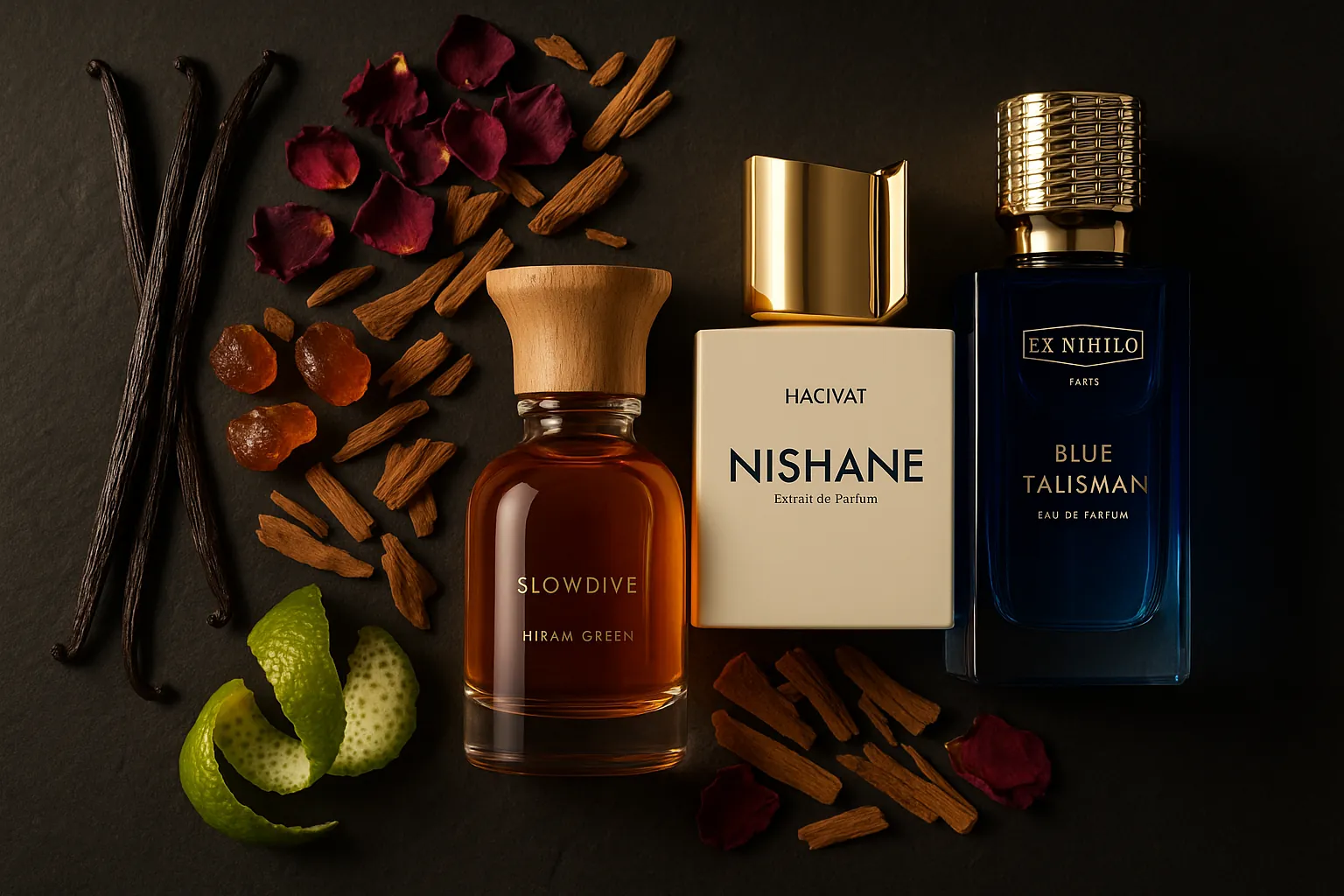
Hiram Green is one of the world's most respected perfumers, working exclusively with natural raw materials - no synthetics, no compromises. His Slowdive combines real beeswax absolute, natural honey, tobacco flower, and neroli into a fragrance that proves: purely natural perfumes can deliver depth and longevity.
Hiram Green's work shows what is possible when a perfumer truly masters natural materials. But even he would not claim that natural is inherently better - it is a deliberately chosen approach with its own strengths and limitations.
The Limitations of Natural Raw Materials
Natural materials are expensive, variable in quality (depending on harvest, climate, soil), and often less long-lasting on the skin. Some of the most popular scent notes cannot be obtained naturally at all:
Es ist zu unterscheiden zwischen den Paaren synthetisch/natürlich und abstrakt/naturalistisch. Das geht auch nicht wirklich in die gleiche Richtung, denn eine naturalistisch riechende Rose ist ohne Synthetik kaum hinzubekommen (weil selbst die schonendsten Extraktion nicht den kompletten Dufteindruck einer blühenden Rose einfangen kann), von Maiglöckchen ganz zu schweigen.
[A Parfumo user explains that we need to distinguish between the pairs "synthetic/natural" and "abstract/naturalistic" - a naturalistic-smelling rose is nearly impossible to achieve without synthetics, since even the gentlest extraction cannot capture the full scent impression of a blooming rose, let alone lily of the valley.]
Lily of the valley (muguet) cannot be distilled - every lily of the valley scent you have ever smelled is based on synthetic molecules like hydroxycitronellal or lilial.
What Makes Synthetic Molecules Special
Synthetic fragrance materials are developed in the laboratory. In 1882, Paul Parquet first used coumarin in Fougere Royale - the first synthetic molecule in a perfume. Today, coumarin is found in roughly 90% of all fragrances.
Since then, synthetic chemistry has revolutionized perfumery. Some of the most important milestones:
- Coumarin (1882) - Opened up the entire fougere family
- Aldehydes (1921) - Made Chanel N°5 possible
- Hedione (1966) - The jasmine molecule in Dior Eau Sauvage, which according to a study in NeuroImage activates the human pheromone receptor
- Iso E Super (1973) - From Dior Fahrenheit to Escentric Molecules 01
- Ambroxan - Replaces ambergris without any whale having to suffer
Synthetics ≠ Cheap
A common misconception: synthetic means "cheap mass-market product." The opposite can be true. Developing a new molecule costs millions and years of research. And not all synthetic molecules are equal:
Chemistry student here. Well, my organic chemistry professor is really interested in aromatic molecules. Every chance he's got he's showing us how to make the molecules that give apples, almonds and peaches scents. Long story short, he said that most of the times they create the same molecules that present in fruits/woods in order to give the same aura of scent to fragrances. If something smell's synthetic, it's not because of the molecule, it's because some molecules are really expensive to make, so companies and perfume manufacturers cut the process short so you don't have the same molecule, but something close to it.
When a perfume smells "synthetic," it is not because of the molecule itself - it is because the manufacturer cut corners in the production process. High-quality synthetics are often indistinguishable from natural raw materials.
Ex Nihilo - "Techno Crafting" as a Philosophy
The Parisian house Ex Nihilo has elevated the combination of nature and high-tech molecules to a brand philosophy. Their approach is called "Techno Crafting" - classic French perfume artistry meets cutting-edge molecular research.
Blue Talisman contains three exclusive Givaudan molecules: Akigalawood (a sustainably sourced patchouli derivative), Georgywood (a transparent wood molecule), and Ambrofix (synthetic amber). These so-called "captives" - exclusive, patented fragrance materials - are combined with natural bergamot and orange blossom. The result is neither "natural" nor "synthetic," but simply: outstanding.
Maison Crivelli - When Molecules Open New Worlds
Maison Crivelli stands for surprising contrasts. Papyrus Moleculaire carries the concept in its name: a fragrance built around a synthetically reconstructed papyrus accord - a scent note that does not exist as a natural extract.
Even more telling is Lys Solaberg: the dominant note is ambroxan, one of the most famous synthetic molecules in modern perfumery. Combined with natural oakmoss absolute and tobacco absolute, it creates a fragrance that would be inconceivable as either purely natural or purely synthetic.
Three Myths That Do Not Hold Up
Myth 1: "Natural Is Safer"
It sounds intuitive, but it is not true. Nearly 80 essential oils can trigger allergic contact dermatitis, including common ones like tea tree, ylang-ylang, and sandalwood.
According to the EU Commission, natural terpenes like limonene and linalool - found in almost every essential oil - become potent allergens through oxidation when exposed to air.
And the EU expanded the list of declarable allergens from 26 to 82 substances in 2023 - 28 of which are natural extracts. The IFRA standards regulate natural and synthetic raw materials equally.
A particularly prominent example: oakmoss, one of the most classic natural perfume ingredients and the foundation of every chypre fragrance, was strictly regulated due to its allergenic properties. Since 2019, only "purified" oakmoss with less than 100 ppm of the allergens atranol and chloroatranol may be used in the EU.
Myth 2: "Synthetics Smell Artificial"
Honestly, I see so many reviews on Fragrantica praising Nasomatto's 'real Oud' when they're kinda famous for being excellently blended synthetics. I realize even the most self-professed experts have no clue what 'natural' smells like.
Even experienced fragrance connoisseurs often cannot distinguish high-quality synthetics from natural raw materials. What we perceive as "synthetic" is usually poor dosage or cheap formulation - not the molecule itself.
Myth 3: "Natural Is More Sustainable"
For some raw materials, the opposite is true. 175 years of commercial harvesting have decimated wild sandalwood stocks by up to 90%. Brazilian rosewood has been under CITES protection since 2010, as each tree yields only 1% oil.
Frankly, I would rather have synthetic if it means that there is less over-harvesting of endangered ingredients. Look at what's happening with the Asian sandalwood trees. They're dwindling at an alarming rate because of over-harvesting. I don't want the eco system endangered just to make me smell pretty. Also, I like the smell of some synthetics. I like ambroxan and ethyl maltol. Plus, they make perfumes last longer.
Synthetic alternatives like ambroxan - originally derived from ambergris, now synthesized from clary sage - can protect animals and endangered plants. However, synthetic materials have their downsides too: older musk compounds like Galaxolide were detected in 92% of water samples from the Great Lakes. Newer generations are biodegradable - progress is happening on both sides.
The Best of Both Worlds
The truth is: modern perfumery has been based on combining both worlds for over 100 years. And that is not a weakness - it is a strength.
Ich bin weder auf dem Naturduft- noch auf dem Synthetiktrip... Für den WOHLGERUCH eines Parfums ist Synthetik m.E. unerlässlich, genau wie natürliche Duftstoffe. Ein gutes Parfum besteht in der Regel aus natürlichen und synthetischen Duftstoffen. So ist das schon seit über 100 Jahren. Ein Chanel No.5, Jicky etc. waren auch noch nie ohne jegliche Synthetik.
[A Parfumo user writes: "I'm neither on the natural nor the synthetic bandwagon. In my view, synthetics are essential for a perfume to smell GOOD, just as natural materials are. A good perfume typically consists of both. That's been the case for over 100 years. Even Chanel No.5, Jicky, etc. have never been free of synthetics."]
A perfumer active in the community described the difference this way:
Natural oils (essential oils/absolute oils/SCO2 extracts/etc) are typically made up of dozens or hundreds of different materials. They're like miniature perfumes in and of themselves with top notes, heart notes and base notes. They're complex and beautiful, but they can only be manipulated in a limited way. They're like photographs. [...] Sometimes, they're direct attempts to reproduce (or improve upon) a natural smell, for reasons of cost, safety or performance. Sometimes, they're just a novel smell, like Givaudan's aquatic smelling Ultrazur base. These are like computer generated images.
- u/acleverpseudonym on Reddit (independent perfumer)
Natural raw materials are like photographs - complex and authentic, but limited in how they can be manipulated. Synthetic molecules are like CGI - precisely controllable and capable of creating entirely new worlds. The best films use both.
Nishane Hacivat - Cult Status Through Combination
Nishane Hacivat is a great example of how nature and synthetics together create something that neither side could achieve alone. The base is built on classic oakmoss and natural patchouli - combined with Clearwood (Akigalawood), a sustainable synthetic molecule that gives the fragrance its legendary projection. A chypre fragrance that would have no soul without the natural elements - and no reach without the synthetic ones.
Initio Side Effect - Hedione as the Secret Ingredient
Initio Side Effect combines natural rum, real saffron, and tobacco with hedione - a synthetic jasmine molecule that, according to researchers at Ruhr University Bochum, is the first substance for which a pheromone-like effect on the human brain has been demonstrated. The natural materials deliver character and warmth, while the synthetic molecule provides the "magnetic" effect that makes Initio one of the most exciting houses in niche perfumery.
How to Experience the Difference Yourself
Theory is helpful, but in the end only one thing matters: how a fragrance smells on your skin and how it develops over the hours. A few suggestions:
- Consciously test natural vs. synthetic. Compare a purely natural fragrance like Hiram Green Slowdive with a modern molecular fragrance like Ex Nihilo Blue Talisman. Pay attention to how they develop throughout the day.
- Give each fragrance time. Natural fragrances often take longer to unfold. Synthetic ones are quicker to "arrive" but evolve less.
- Trust your nose, not the label. What matters is not whether it says "natural" or "synthetic" on the bottle, but how the fragrance makes you feel.
Not sure where to start? The AI fragrance advisor can help you find fragrances based on your preferences - whether you lean toward natural complexity or modern molecules. And with a discovery box you can compare different approaches directly on your skin.
Key Takeaways
- "Natural" is not a quality seal - and "synthetic" is not a flaw
- Natural raw materials deliver complexity, depth, and a vibrant scent evolution on the skin
- Synthetic molecules enable longevity, consistency, and scent notes that do not exist in nature
- Allergens are found in both - IFRA regulates natural and synthetic materials equally
- Sustainability has no clear winner - sandalwood is endangered, but synthetic musk compounds also pollute waterways
- The best fragrances combine both - and have done so for over 140 years
Do not let labels guide you. Smell for yourself, test on your skin, take your time. Whether the molecules come from a flower or a laboratory is ultimately less important than the question: How does this fragrance feel on my skin?
Read next
How to Test Perfume Before Buying: Skin, Samples and Time
Testing perfume before buying means wearing it on your own skin for hours, not judging it from a paper strip. Here is how to use samples, avoid blind buys and make better fragrance decisions.